Best Index Funds Examples: Top Choices for Broad Market Growth
Grow your wealth. Learn how to invest in index funds examples, mutual and index funds, invest mutual funds and understand the basics of long-term wealth...
For countless investors, stepping into the financial markets often kicks off with a big, intimidating question: "What should I buy?" With a vast array of options—individual stocks, bonds, real estate, commodities, derivatives—it is easy to feel swamped. But most folks building long-term wealth find their answer not in picking individual securities, but in pooled investment vehicles like mutual and index funds. These allow regular people to own diversified portfolios of dozens, hundreds, or even thousands of underlying assets with just one purchase. Grasping the landscape of mutual and index funds, their unique traits, and their roles in a portfolio is a must for anyone looking to invest mutual funds effectively. This guide offers a thorough look at various types of mutual funds, concrete index funds examples, practical selection criteria, and answers to common questions like is mutual fund a good investment for your situation. Whether you are a newbie crafting your first portfolio or a seasoned investor fine-tuning your asset allocation, mastering these foundational tools is key to long-term success.
Mutual and index funds tackle the three biggest hurdles individual investors face: diversification (spreading risk across many assets), professional management (or systematic indexing), and accessibility (low minimum investments). Just one fund can offer instant exposure to the entire U.S. stock market.
What Are Mutual and Index Funds? Core Definitions
Before diving into the details, it is crucial to understand the basics. Both mutual and index funds are pooled investment vehicles: they combine money from many investors into a single fund, which then buys a portfolio of securities (stocks, bonds, or other assets). Investors own shares of the fund, and the value of those shares rises or falls with the portfolio. The key difference between active mutual funds and passive index funds is in their investment goals and management style. An actively managed mutual fund employs a professional portfolio manager and research team selecting securities to outperform a benchmark index. In contrast, a passive index fund aims to mirror the performance of a specific market index (like the S&P 500) by holding the same securities in the same proportions, without trying to beat the market. When someone asks what is an example of a mutual fund, they might mean either type—but fees, risk profiles, and expected returns can differ greatly.
Active vs. Passive: The Fundamental Trade-Off
Understanding what mutual fund structures exist involves grappling with the active versus passive distinction. Actively managed funds offer the potential for above-market returns (alpha) but come with higher costs (expense ratios typically 0.50% to 1.50%), manager risk, and the fact that most underperform their benchmarks over time. Passive index funds provide market-matching returns, ultra-low costs (expense ratios as low as 0.03%), and predictable performance. For most long-term investors, the evidence overwhelmingly favors passive indexing. However, some market segments (like small-cap stocks or emerging market bonds) might present inefficiencies that skilled active managers could exploit. When evaluating is mutual fund a good investment, it all boils down to the specific fund's fees, strategy, and track record against a suitable benchmark.
- Ultra-low expense ratios: Typically 0.03% to 0.10% annually, minimizing cost drag on returns.
- Predictable benchmark tracking: You know exactly what you own and how the fund will behave.
- Tax efficient: Very low turnover minimizes capital gains distributions.
- No manager risk: Performance does not rely on any individual's stock-picking skill.
- Higher expense ratios: Typically 0.50% to 1.50% or more, creating a significant headwind.
- Potential for outperformance: Some managers beat benchmarks, but persistence is rare.
- Tax inefficient: High turnover generates annual capital gains, even if you do not sell shares.
- Manager dependence: Key personnel changes can dramatically affect future performance.
Various Types of Mutual Funds: A Comprehensive Taxonomy
The wide world of various types of mutual funds can be sorted by several criteria: asset class (stocks, bonds, or both), investment style (growth, value, or blend), market capitalization (large-cap, mid-cap, small-cap), geographic focus (domestic, international, global), and management approach (active or passive). Understanding this taxonomy is vital for crafting a diversified financial mutual funds portfolio that matches your risk tolerance and time horizon. Below is a breakdown of the major categories.
Equity (Stock) Mutual Funds
Equity funds invest mainly in common stocks. They are further divided by market capitalization. Large-cap funds focus on companies with market caps over $10 billion (think Apple, Microsoft, Johnson & Johnson). These tend to be more stable and often pay dividends. Mid-cap funds target companies between $2 billion and $10 billion, offering more growth potential with moderate volatility. Small-cap funds invest in companies under $2 billion, boasting the highest growth potential but also the highest volatility and risk of permanent loss. Additionally, equity funds are classified by investment style: growth funds look for companies with above-average earnings growth (often not paying dividends), value funds seek undervalued companies trading below intrinsic value, and blend funds mix both approaches. An example of what is an example of a mutual fund in this category would be the Vanguard 500 Index Fund (VFIAX), which tracks the S&P 500 large-cap index.
Fixed-Income (Bond) Mutual Funds
Bond funds invest in debt securities from governments, municipalities, or corporations. They are categorized by credit quality (investment-grade vs. high-yield/junk), duration (short-term, intermediate-term, long-term), and issuer type (Treasury, municipal, corporate, international). Bond funds offer regular interest income and are generally less volatile than stock funds, making them suitable for capital preservation and income generation. However, they are not risk-free: rising interest rates can make bond prices fall, and low-quality issuers might default. When selecting a mutual fund for the fixed-income portion of a portfolio, prioritize low-cost, broadly diversified options like a total bond market index fund.
Index Funds Examples: Major Categories and Specific Funds
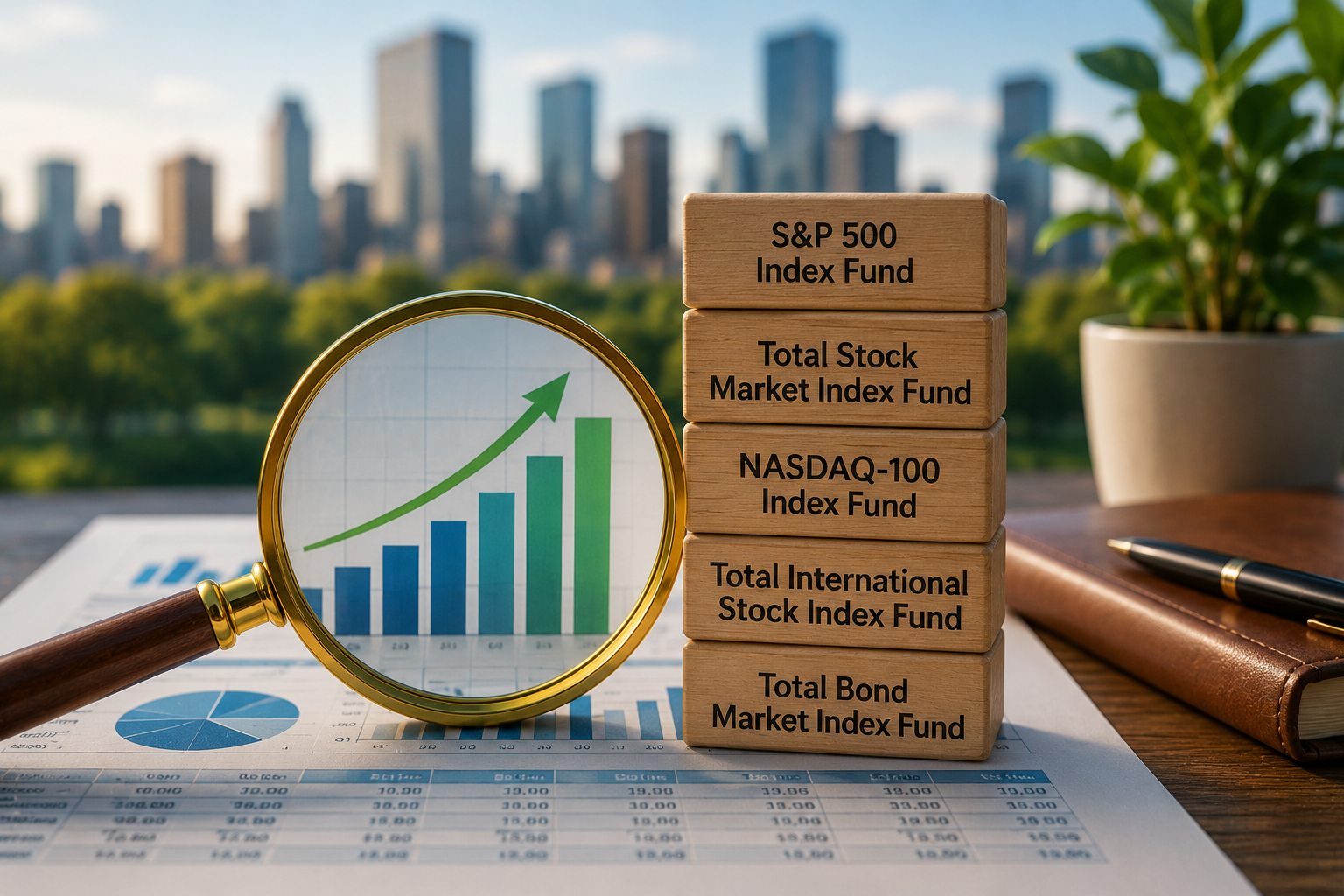
To make this idea concrete, here are specific index funds examples across major asset classes. These funds represent the gold standard in passive investing and are widely available through major brokerages. Understanding these type of mutual funds (specifically, index funds) provides a practical starting point for portfolio construction.
Start Building Your Low-Cost Portfolio Today
The evidence is clear: low-cost index funds are the most reliable path to long-term wealth for individual investors. Use our free compound interest calculator to see how even a 0.50% fee difference compounds into tens of thousands of dollars over decades.
Calculate the Impact of Fees →